

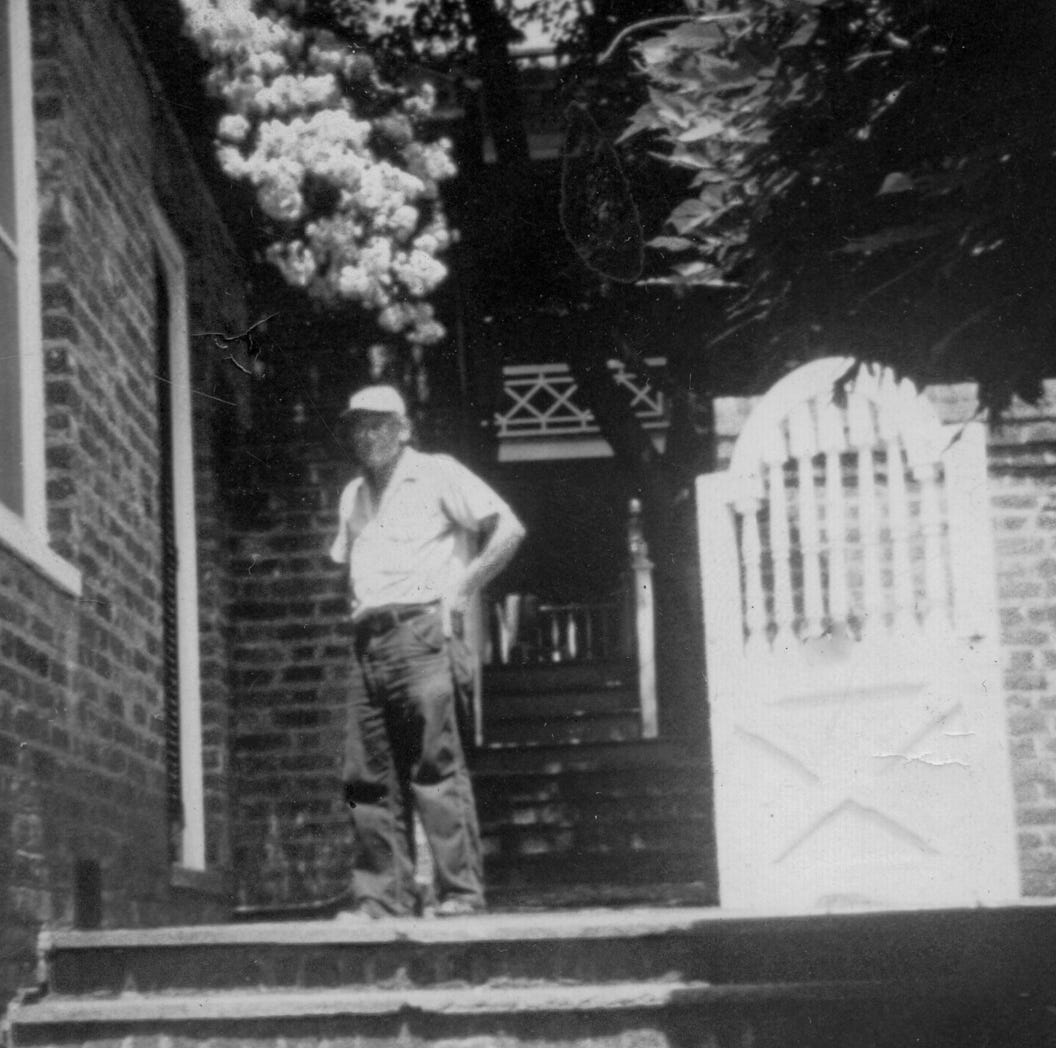
Benny
Benny had grown up on Cedargraves long before the Neary Family had any idea they would leave Buffalo permanently. Buffalo was beginning to lose some of its luster. People were talking about the warmer states being where things were happening. The cold winters and lake effect snows were taking a toll on their soft modern lives, so Clayton set out to find a place with the ideal soil and a good climate to farm cattle.
Benny, the Neary’s groundskeeper, was a grizzled man with a smoky voice, usually in blue jean coveralls and a red plaid shirt like the famous picture of Charlie Parker. With a wet cough to match, a non-filter cigarette usually hung from his swarthy face, usually shaded by an old brown fedora with cracks in the folds.
He appeared to have arrived out of the Great Depression and the Farm Security Administration, a living Walker Evans portrait. Jasper’s best friend in high school, Peter Vazonnabe, had given him The Americans, and he would remember Benny as if he’d stepped right out of it.
Benny and his wife lived in a white frame house on a hill west of the big house with tall shade trees around it. The drive wound up through the pasture above Clayton’s office. The home was neat and clean in old-fashioned, floral wall paper, with an upholstered couch in laurel crown, and matching easy chairs comfortably in front of the fireplace. The curtains were usually kept closed making it dark inside, its plain interior protected from the broiling Virginia sun.
The children were always welcome. Jasper often visited Benny’s home with his tribe in tow. Not having known many laborers in his short life, the boy was touched by how spartan its interior was.
He loved the old-fashioned, hanging porch swing on two chains bolted to a sturdy ceiling of wainscoting. The porch faced a cloistered yard under Tulip Poplars, Red Maples and Oaks, the yard distinguished with the smell of wisteria and lilac. From the screened porch you could see Clayton’s viridian colored polo barn and the small block building near by that was his office. In the big house, there was a striking photograph of Clayton standing below Benny’s crib with three of his prize Angus bulls.
Benny would walk to work at the big house early each morning—down one hill, over a brook flowing off the mountain, and on up a second steep rise.
On his way to his toolshed, he passed through a small gate with a metal spring forcing it shut, gradually uphill along a line of cedars next to the split rail fence separating the pasture from the garden. Next to his path was a broad terrace set aside for vegetables. Finally he scaled the tall rock wall to the garage yard by way of a steep set of flagstone steps.
In the vegetable garden he tended a large asparagus patch in the spring. The fresh asparagus was served on toast and basted with melted butter. If the rains were good in the summer, there would be a stand of sweet corn. Freshly picked corn on the cob was Clayton Neary’s favorite. He swore the only way to eat it at its sweetest was to have the water boiling on the stove ahead of time, pick it and race like the dickens to the kitchen.
****
Benny had a kind and gentle nature. He didn’t mind the children interrupting his endless groundskeeping. There was no pressure as long as the place looked good. He truly enjoyed their company fielding the sprouting cousins’ endless questions with imaginative answers.
They knew Benny was of the place and knew its deepest secrets, all of which fascinated the little grasshoppers. Whether he embellished his monologues or not didn’t matter to them. The tales captured their attention and stimulated their starving curiosities.
Benny grew older before their eyes. Some were too young to remember him later on, but Jasper, being the oldest, never forgot Benny’s affable Hollywood way, like a character out of Treasure of the Sierra Madres, or elsewhere in Jasper’s budding love of movies. His favorites were morality tales about moral imperative and absolute justice. Benny was a righteous man and good to the last drop. He fit right into Jasper’s sympathy for the underdog, characters challenged to defy moral ambiguity.
One day, not long after they’d lost their grandfather in the family schism, Benny was gone too. The children, having lived sheltered lives of plenty, were unfamiliar with death. Benny’s passing was hard for them to believe, and for a while there was a lot of sadness and fewer expeditions to the outer reaches of the farm where his stories were set. Then Reg signed on, whom the cousins had to call Mr. Miles. He would do his best to fill the enormous shoes of their beloved Benny.
****
In life, Benny had peaked their interest with his stories of unknown grave sites and eery phenomena on the thousands of acres of sprawling farmland. Raised on Cedargraves, after his kin died he came to work and live next to the main house. He hadn’t dared get near the crude cemetery near his childhood home in almost fifty years, hinting at more to the existence of the old graves than met the eye. He’d deliberately forgotten the places, or feigned it not wanting to scare them, but he underestimated their curiosity and determination to learn more about death and final resting places.
With Jasper’s oversight, the children organized a series of expeditions on foot to rediscover the lost graveyards in distant corners of the farm. One of them was a place with a single line of cedars, each planted above one of seven hastily improvised graves, each resting place marked by a crude piece of field stone.
“They wouldn’t look very natural-like. They’d be different than a random scattering of wild cedars” he told them.
Benny offered them clues to their whereabouts beneath a saddle at the bottom of the steep mountain than ran the length of the farm. Like a painting, a ruined house sat there for what must have been decades and decades. Legend had it, it was the oldest house in the county dating to the colonial era, with nothing much of it left but a few walls, and piles of two hundred year old, handmade brick.
With his approximate directions, Jasper led the top secret, imagination-crazed treks across the endless-seeming rolling expanses to find the mysterious graves. On both flanks of the property, forested hillsides merged with a central valley interspersed with swamps and ruined hay barns, and long abandoned share-cropper homes teeming with black snakes and yellow jackets.
The children penetrated deep into the eastern end of the farm searching for the cedar graves, several miles walk round-trip from home. It took several missions before they found the exact spot where the seven cedars stood, straight as flagpoles above seven pieces of gray slate sitting vertically in the red dirt. It really existed.
The stoic cemetery had been violated for years by generations of ground hogs, the graves barely recognizable. Holes penetrating the forgotten plots burrowed right into the center of the resting places, but the mystery wasn’t solved. There could be little doubt where the farm had gotten its name, but who lay below the seven cedars?
Clayton Neary had known about the cemetery for years. Sounding a bit like Will Rogers and partly feigned, he’d say, “The only way to tell if them graves are slaves or soldiers, or which flag they died for would be to dig one up and look for buttons or buckles amongst them bones.” Jasper thought it sounded like a perfect afternoon’s project, but it was a little too exotic for the grown-ups to wrap their heads around.
The official story was, after a short skirmish the graves had been hastily dug for a handful of confederate casualties. The trees were planted just far enough apart to fit the bodies in next to each other in a single row. They were likely buried in haste, after which the living soldiers moved out quickly fleeing their enemies.
Or was it they’d moved towards their adversaries in a bitter pursuit for revenge, or survival, desperately defending positions in an ongoing skirmish?
It had been one hundred years of solitude for the young bodies surrendered to the earth—red earth rusted with iron and stained with the blood of mangled bodies missing limbs, and faces with crestfallen expressions and unseeing eyes, frozen still in death after the violent, gruesome expiration of their young lives.
Before laying the bodies in the soil, the accidental morticians likely stripped them of critically necessary items like boots, gloves, buttons and belt buckles. So it was possible there was nothing down there but bones, which might also have indicated it was the resting place of slaves.
The trees hadn’t forgotten their solemn obligation. They’d grown fifty and more feet high and two feet round with bark like torn paper, having survived the decades to mark the last resting places of unlucky children relegated all too soon to the good earth. Long gone to the afterlife, Jasper prayed they were content in heaven.
Another cemetery on the west side of the farm was that of slaves. White scattered headstones and a few foot stones lay under tall walnut trees having taken advantage of the graveyard’s protection. On one headstone read, “In slavery and in freedom...,” proving it was the segregated resting place of Africans brought to America in bondage. Having survived emancipation, they’d rated real headstones engraved with loving epitaphs.
Jasper occasionally rode by the scattered stones of the glade on Caesar, paying his respect and pondering the complexities of past lives burdened by forced bondage. Like Sherman’s march to the sea, time had erased almost all trace of it.
****
In the rear of the main house’s kitchen, a backdoor led outside onto a battleship gray porch with a white railing built around an enormous maple. Delores’s last pet, a wolf-dog named Chuchi was usually splayed out on the porch asleep, for Delores strictly prohibited animals in the house. With the children’s adoration, Chuchi didn’t care. He too would soon be resting in the good earth under a bed of ivy and blue flowers with a stone etched: Chuchi – 1952-1965 – Our Friend.
Two sets of stairs led down in different directions around the enormous tree. At the bottom, flagstoned paths led in three directions past a large cast iron bell with a rope pull on a crude cedar pole.
Straight took one past the bell and through an open, arched balustrade door into an alley between the garage wall and a servant’s room opposite. In the warmer months, one passed a transcendent wisteria covered with purple flowers and thousands of bees milking its nectar. They carried loads of pollen on their feet to another wisteria fifty yards south in the formal garden.
Through the alley and past the transcendent wisteria, one descended a wide flight of flagstone steps and past an open shed on the right opposite the entrance to the garage. Clearly older than the surrounding outbuildings, it likely once had something to do with horses or storing firewood in olden days, later used for general purposes by the Nearys.
A wide dirt yard led into a four car garage. The shed and two free-standing guest rooms with hexagonal slate roofs gave the yard a medieval look. The children had a choice, turn the slate-roofed quarters into old English ramparts and stage a siege, or make them parts of a pretend Deadwood on the western prairie.
For years Benny had taken wonderful care of the grounds, but years later it would be Miggy who made it her business to tend the formal garden she adored above all, her nature, the love of all things living, furred, feathered and green. Her commitment to the house and grounds was based on true love, it having been her adored childhood home, but with little appreciation shown the elder by powers that would paint her out.
Attached to the garage and close to the garden, a regular stop in Jasper’s rounds, was a crude unlit toolshed with heavy latched wooden doors painted white. Inside, Benny’s well-worn bench held sway, drenched in years of Three in One oil, sitting on a dirt floor against the inside of the stacked stone wall that separated the formal garden from the yard.
The garden’s footprint was an enclosed half-acre square with four large magnolias, one in each corner. In the spring they were laden with large fragrant white flowers. A series of symmetrical brick walkways led to a fountain in the center. An enormous rock wall separated it from the yard outside the garage. An arch with a white wooden door matching the door to the toolshed, led through what Jasper called, “The door to paradise itself…,” a green quiet place, fragrant with bulbs and magnolia blossoms, and in the spring dappled with wild dogwood and a second even bigger wisteria, glorious in its own transcendence.
In the winter, Delores burned coal in her two open fireplaces. Having been born in Buffalo in eighteen ninety-two, you couldn’t take the Gilded Age out of her. She knew how she wanted to heat her home and that was always unconventionally with anthracite coal. Her storage bin was directly under the second guest room, a grimy, dirty dark place that turned the children instantly black if they breached the sign that read, “Children Keep Out!”
Above the bin, a wooden staircase led steeply up to the guest room’s front porch where a door led into a floral-papered room with an old-fashioned essence. With a view to the west, it had a cast iron bed with a cheerful bedspread, and featured an impressive view of the yard and garage below. The children considered it a perfect hideout.
Like a set from Gunsmoke, they played pretend Old West up and down the stairs. Jasper’s love of cowboys and his lively imagination was their catalyst. In their young minds, each was in their own imagined private idea of Tombstone or Dodge City, images garnered from television’s obsession with morality tales. A few of the children always insisted on being Native Americans, Delores having friends in Arizona on the Navajo and Hopi reservations, and having instilled a respect in them for aboriginal peoples.
****
Besides Benny, Jasper’s earliest memories included an enchanting black man they called Gunnar. He managed the coal bin, and in the winter made sure the coal was taken up to the big house early each morning. On cold mornings, Jasper remembered a handsome, dark-skinned black man with a well worn fedora and a frayed dark coat, his deep voice quietly conversing with his grandmother.
He seemed to move in slow motion, talking slowly and politely, an honest and dear African American forced by his race to eke out his survival. Jasper often wondered why it was almost a law that black people were not be paid a living wage, and were customarily forced to live in poverty. America was supposed to be a great nation. What was wrong with Americans, he often thought?
His grandmother would ask the fascinating black gentleman, “How’s that latest great-grandchild coming Gun?”
Gunnar responded with a touch of melancholy in a deep, sad voice with the timbre of Paul Robeson’s, “Bless you Miss Delores for asking. Fair to middling I’m afraid.”
Sickle cell disease was not uncommon amongst the African American community during Jim Crow. If medical care was even available, it was substandard. Delores did what she could to help them out, but sickle cell and poverty would take its toll without the kindness of people like the Nearys.
In the Civil Rights era, when Jasper was in high school, he proudly carried his NAACP membership card, attended meetings, and marched through his Connecticut home town in support of the new era in race relations. It made him sick the southern states unanimously blocked anti-lynching legislation that would have saved many black lives. It was all a mystery to him.
Jasper believed racism and the injustice perpetrated on the descendants of slaves was the incarnation of pure evil. It tore the heart right out of his chest.
Delores continued emphatically, “Gunnar… you must tell me if there’s anything at all we can do?”
“Yes, ma’am, I reckon I should. I will. Yes ma’am. Thank ya, and God bless you Miss Delores.”
“Gun, you think nothing of it. Mr. Clayton would’ve insisted.”
“You’ve already been so kind Mrs. Neary.” Switching to a more formal tone, Gunnar was a master of gratitude and the essence of courtesy unlike so many white folks.
****
Chapter Eight
This is a work of fiction. Names, characters, places and incidents either are products of the author’s imagination or are used fictitiously. Any resemblance to actual events or locales or persons, living or dead, is entirely coincidental.
Tony Heath is an artist, jazz musician, activist and writer of fiction and essays in Arizona. He and his wife, Kate Scott, co-founded a wildlife advocacy on their ranch in Cochise and Santa Cruz Counties.
THE GREEN SAFE © copyright T Heath, 2026
Photographs by T Heath © copyright
Not written with Artificial Intelligence • Not available for AI training