

Back by popular demand:
Devotion
It was July of nineteen sixty-three. In the small town on the edge of the broad, Atlantic coastal plain, the train came to a gradual screeching stop. A black porter in tidy white lowered the stairs from the vestibule and two small children disembarked into a blast of humid air.
The antebellum station built of old trees, barely serviceable, was centered on a long curving platform, also crafted from aging sticks. The tracks between Alexandria and Charlottesville, Virginia traced a gentle arc as they entered the small town of Gordonsville.
To the north of the tracks sat shambly homes with tar-paper roofs. Lined with forsythia, each had a porch with a swing hanging from two chains. Rocking chairs obliged unknown black lives. Cheerfully white-washed, they rose from muddy yards of scuttling children and barking dogs. To the south of the tracks was Main Street, laced on each side with Impalas, Falcons, and rusting pickups covered with manure. Handsome antebellum storefronts of brick sat proudly under signs with names like Fitzhugh Motors, Rexall Drugs, Miller’s Diner and IGA.
Their grandfather, Clayton Tyler Neary, had built the first swimming pool for the colored children across those same tracks many years previous. Colored was how they were referred to in those days before civil rights. The black kids knew all too well they were brought to America as slaves and were known as negroes in polite society. They led lives of incomparable privation. Clayton, a Roosevelt Democrat, believed they deserved the same pleasures and comforts as white folks, but was loath for a solution to their suffering given systemic racism south of the Mason Dixon Line. For some reason white people didn’t see it Clayton’s way. Jim Crow was still a ruthless demon walking the streets and back roads of Gordonsville. They called Mr. Neary, Papa. His gesture of kindness would at least be a beginning.
Benny would be waiting at the station to shuttle Alyson and Jasper Holmes up over the wooded pass in the Southwest Mountains and down the long red dirt road to the Cedargraves mansion. He’d be driving the green farm truck with its formidable, iron-willed steering wheel before power steering. The boy adored pick-up trucks, but they weren’t needed in the suburbs up north where folks didn’t do any of their own work, so a visit to their grandmother’s meant he could feast on his fasciations with rural life, which included pickups and tractors mostly.
They usually arrived at the farm close to dark after they’d traveled alone by train from Fairfield County in Connecticut. Through Penn Station, down the eastern corridor to Washington, over the Potomac, a final stop in Alexandria and they passed into the pastures and rolling hills of the Piedmont and into the withered train station at Gordonsville.
In those years small children could travel alone by train. They were well chaperoned by the dedicated black porters and white conductors in neat blue uniforms. It was a different time in that respect, a prosperous time in post-war America, and children were safe traveling alone by train. Middle class white people were happy and comfortable with their lives. The war in southeastern Asia had barely killed a handful of unlucky boys.
Cedargraves Farm was three square miles of iron-stained dirt roads out of the previous century and earlier. Scarlett roads led to fields of cow corn and pastures of alfalfa. Clayton had build barns the size of dirigibles with silos as big as submarines on end. It was reported Clayton Neary brought the Angus cattle breed to Virginia as president of the Stockman’s Association.
When the Nearys came to Cedargraves in nineteen twenty-four, antebellum pastures were separated by split-rail fences following the archaic tree lines left by early clearing. Barbed wire would gradually take their place. There were small patches of forest in the bottomlands, the last in the valleys between hills some called mountains, perfect cover for deer and turkey or bovines escaping the humid sun.
There were secret ponds in the woods the cousins frequented, playing out the settling of the West or “Civil War,” puerile imaginations reenacting what they saw on television and in the movies. They explored the vast interiors of the huge hay barns, until a black snake would drop from a rafter and they would run screaming in all directions.
There were abandoned farms within the farm. Hidden in forgotten woods on three thousand acres of low hills, brooks, swamps, hollows and vales, were long abandoned plank houses. Weathered steps led to rotting porches waiting for victims to step through. Inside were the remains of plaster and lath walls decorated with racy graffiti and hearts proclaiming the names of lost lovers scratched into the plaster where the wall paper had long since peeled away. Dead, outdated wires hung from what was left of the ceilings, or they traversed the crumbling baseboards leading to old-fashioned junction boxes. The skeletons of the ghost houses were in the final stages of decay, unloved and rotting in the wet springs and humid summers, once homes to real lives lived and forgotten. Lost to time, reduced to eery hulks hidden in clumps of honeysuckle and poison ivy, they’d been given up for lost—irrelevant after decades of decay.
Cedargraves was a place where history had come and gone with eerie finality, like faded photographs of unknown people in coveralls next to wagons with mules, or a sketch in wash on a faded yellow page. The oldest house in the county, a colonial treasure, lay in a pile of bricks at the top of a deserted hill in the back of the farm. At the bottom of the hill, a lost, crude cemetery marked the spot where soldiers fell fighting for and against freedom, hastily laid to rest ninety years previous, when with blood and tears America had begun to slowly civilize itself in deadly civil conflict with itself.
****
On a flat above and to the south of a wide valley they’d built the original manor house. It had stood with unequaled elegance on the side of that mountain long before the Nearys arrived. The Nearys had loved it unequivocally, as all great houses must to survive. They’d raised four beautiful children in its cavernous rooms before life’s challenges began to take a toll on them, their picture-perfect lives lost to memory and imagination, and the camera’s lens.
As is typical of human life, every Neary did not honor its history—their own, as the modern world divided and separated in a maelstrom of consumption. It was nothing short of a horserace when Delores died, and the family descended into contention and a bloodbath of entitlement. Time had taken its solemn toll with impunity and not one would be left standing as they’d been in happier times. Nor had it seemed to have dawned on them how terribly fortunate they’d been to have it, or how principled it would have been to preserve their endowment for each other, the stewards of a great place. And so, the family fractured and disintegrated and Cedargraves was lost.
Cedargraves, the site of great drama—a place where past lives had been reborn—and future lives would emerge from the wreckage of wasted values the family had once championed. The magic of a great place was carelessly squelched and discarded. Paradise had been lost.
For the Holmes, Cedargraves was their Eden and nothing could compare to their contented and frequent visits into its Elysian Fields. Later when the siblings were adults, Miggy would have her own home on the site of Cedargrave’s gatehouse above the lake, on the farm she’d been raised and loved more than any place else. As a lifelong early riser, misty mornings above the lake were always her favorite time of day.
****
For them it wasn’t a bad time in America. The suffering on back streets and in urban ghettos was hidden from view. Art was flourishing in decaying cities and for Americans like the Nearys and the Holmes, leadership prevailed. The political parties still respected each other and worked more closely together, but all was not equal. African Americans were suffering. The evil of segregation was rampant and what President Johnson would coin, the Great Society, was still on the horizon and hardly a new deal everybody agreed on.
Sixty years later, having risen from the grave, the nation would still be tormented by a virulent and bitter form of racism. Good and evil would be in outright war. A future for all life in balance with the Earth seemed less assured with each passing decade—if at all—the sanctity of Earth for children that followed impossible to guarantee. It seemed, the human race itself was threatened with extinction.
After Jasper and Ally’s idyllic childhood, things would improve little for the common man in the decades to come. Consumerism and a vibrant economy would not save them, as wealth was consolidated to fewer and fewer at the top. The rich would continue to rape and pillage the oceans and forests, dirty the waters, and overbuild to the detriment of wildlife and protected places.
The world would descend into what seemed to be derangement. A system tailor-made to the obsessions of men of greed and dishonor, out of control, would alienate an entire segment of society. Like canaries in a coal mine, legions of unhappy voters would stray to the promises of liars and hucksters. Trillions of dollars would migrate upwards to a few at the top gaming the system and refusing to pay taxes.
It had all been started by the phony ideas of a B-movie star, later super-charged by a reality TV personality without the skill or values to even be a president, driven upwards by liars and scoundrels with visions of only personal gain at the expense of millions of others. America would not progress a whole lot farther past the days when sister and brother had traveled to their favorite place on God’s Earth.
Soon, children would be stalked on sidewalks and in playgrounds by predators history never imagined when old-fashioned values were alive and well. A new technology would embolden the equivocators and turn profit to religion. The people’s guns and their disagreements and frustrations would lead to the massacre of schoolchildren at their desks and an explosion of self-harm. America’s exportation of its culture would blow up in its face. Decade after decade the world could not produce a leader of vision for all the inhabitants of a shrinking world of oppressive self-interest.
****
When they were just eight and ten years old in New York City, Jasper and Ally Holmes had walked home alone from the School of the Church of the Heavenly Rest, down Madison Avenue, stopping at the Soupburg and on to eighty-sixth street, where they would cross the park and walk up Central Park West to their apartment on the corner of west eighty-eighth street.
They’d spent a year living on Central Park West around the same time Martin Luther King had voiced his “I Have a Dream” speech. John Coltrane was recording Giants Steps, his crescendoing masterpiece napalming the shapes of things to come, paving the culture with asphalt in clairvoyant anticipation of Hendrix and Jim Morrison, expressionistic martyrs of ill will. All would rise above the cascading ethos of Vietnam and Civil Rights. On the stage, Bernstein and Sondheim were putting the West Side on notice.
****
Coming down off the winding mountain road, they turned right through two stone pillars with cemented marble slabs reading Cedargraves in fancy, etched script. The pillars anchored a large wrought iron gate that was always open.
In the rich iron soil, the surrounding pastures bore the temporary, blood-red wounds of the plow. Others seemed decorated with rectangular bales of alfalfa. They motored east along grassy pastures filled with Angus cattle and past the old gatehouse. By the emerald barn that once held Papa’s polo ponies, they navigated a steep curve ascending a dusty road flanked with legions of lilies and enormous overarching trees.
At that time, the road was still lined with picturesque split-rail fences. On both sides, the giant oaks and maples sheltered an exaltation of orange lilies growing ten feet thick by the road, gracing the drive like dabs from Pissaro’s brush.
As the green truck climbed higher, an icon of southern quintessence gradually revealed itself perched high above an olive colored lake, a grand brick home asleep on the hill.
The columned brick house was lined with boxwood sitting beside a grassy circle anchored in the middle by a spiked Holly with red berries. A wood post with a large bell welcomed the visitor up a short brick stairway and onto a walkway leading to the front door, guiding them along fragrant boxwoods on both sides. Matching outbuildings, impressively well suited to the spacious grounds, faced the south end of the circle.
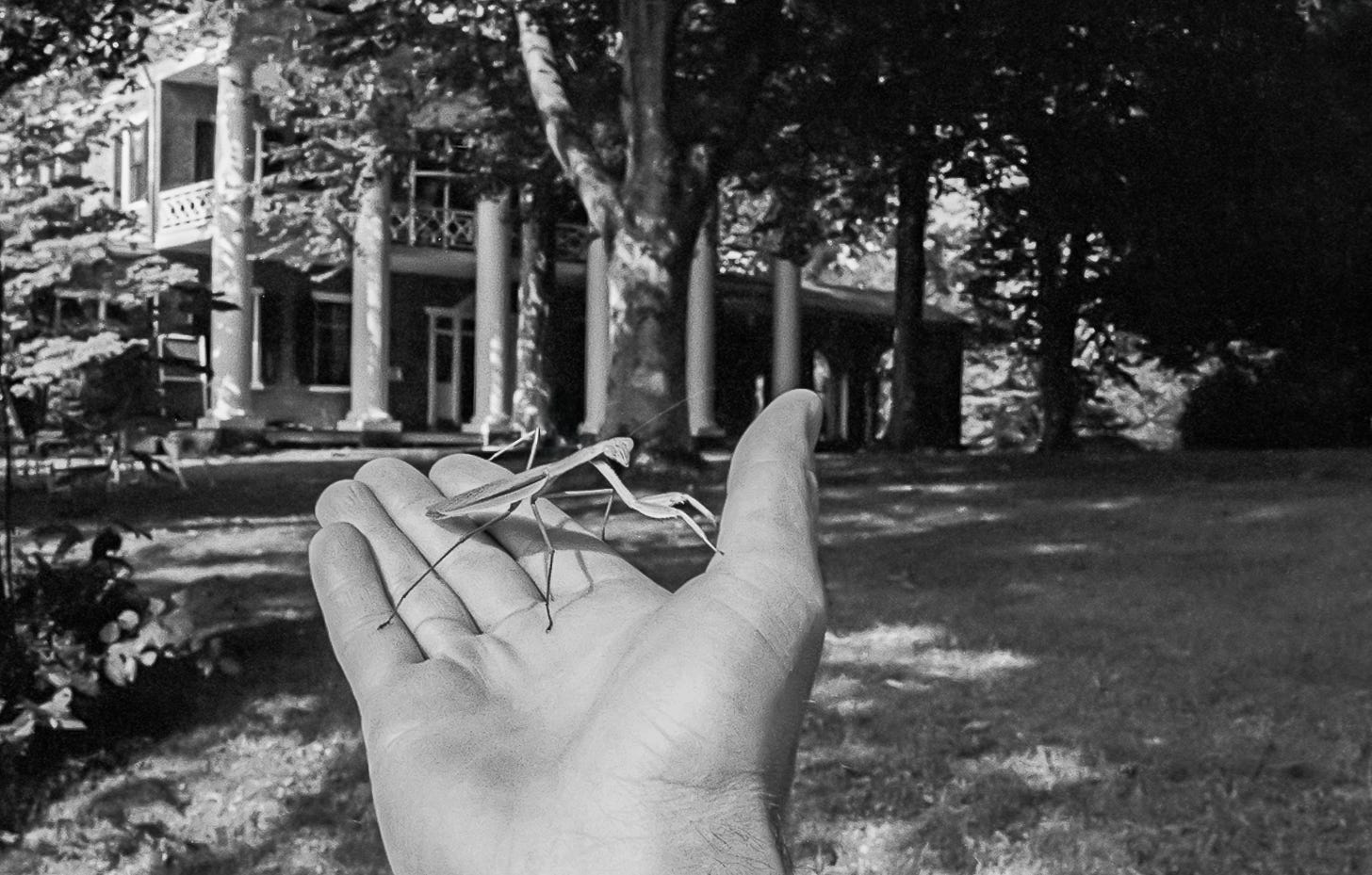
The brick Greek Revival structure had white trim and enormous white columns front and back. The front ones had been salvaged from the old Richmond courthouse at the time of the Confederacy, before any of them had been born. It resembled nothing short of a three story temple with a majestic pediment supported by six fluted columns supporting a grand front porch with matching wood rocking chairs, its peer facing the mountain in the rear.
Across a spacious back lawn peppered with mature boxwoods and a yellow swing set, sat a forlorn brick structure with shuttered windows next to an enormous black walnut. Originally the slave quarters, it was build into the side of the musty mountainside. Shaded by dogwood and broadleaved second growth, it sat just at the edge of the mountain’s rise, emerging from a natural garden of knee-deep vines and shrubs. The scent of boxwood and honeysuckle ingratiated the senses, expanding the mind to the melodious serenade of crickets that never seemed to stop.
The palatial home was the backbone of Cedargraves—its pomp and flair—a place where on that very spot Robert E. Lee had courted a young lady dressed in a flowing calico gown; a place Jefferson himself would have been envious. Located on the side of the same Blue Ridge foothills, some said Cedargrave’s beauty put even Monticello to shame.
****
Chapter One
This is a work of fiction. Names, characters, places and incidents either are products of the author’s imagination or are used fictitiously. Any resemblance to actual events or locales or persons, living or dead, is entirely coincidental.
Tony Heath is an artist, jazz musician, activist and writer of fiction and essays in Arizona. He and his wife, Kate Scott, co-founded a wildlife advocacy on their ranch in Cochise and Santa Cruz Counties.
THE GREEN SAFE © copyright T Heath, 2026
Photographs by T Heath © copyright
No Artificial Intelligence • Not available for AI training